David Sutter Author on Writing Morally Complex Characters in "The Hustled"

David Sutter carves his morally complex characters out of consequence, not convenience. In The Hustled, Cav's ambition, loyalty, and every price he pays for them are tested under real stakes, never handed a hero's easy pass. Esmeralda and Gustave LaBlanc complicate every alliance Cav forges, dragging readers into a cold reckoning between redemption and ruin as the high-stakes Monaco nine-ball match bears down on him.
Key Takeaways
- Cav's journey runs from the dust of Kansas to the marble floors of Monte Carlo, staking everything on the nine-ball matches at the heart of The Hustled.
- David Sutter's own obsession with billiards shaped The Hustled across continents and decades, long before it became his 2017 screenplay.
- Morally complex characters drive The Hustled's narrative, fusing pool mastery with redemption and stakes that cut close to the bone.
- The story fuses high-stakes gambling, artistry, and rebellion into one relentless pursuit of triumph against destiny.
What Makes Cav a Morally Complex Hero?
Contradiction defines Cav. A teenage outcast from the dust and quiet desperation of Kansas, he reinvents himself into a pool mastermind who survives by outthinking men twice his age and far more dangerous than he is. That climb from small-town nobody to hustler with real money and real blood on the table gives **The Hustled book** its emotional spine. Cav is never simply good or simply ruthless — he is both, depending on what the table demands of him that night.
His romance with Esmeralda deepens the instability. Obsession and love tangle together in his decisions, pulling him between the discipline that made him a pro and the recklessness she stirs in him. Every match he plays afterward carries her shadow across the felt.
Why do readers connect with morally gray protagonists like Cav?
Fiction readers gravitate toward character over information, toward the pulse of a life over the bare recitation of events. It's a dynamic the Chip on Your Shoulder blog captures when it notes that choosing fiction means choosing story and character above events themselves. Cav rewards that instinct. His flaws feel earned, not decorative — the engine behind morally complex characters in fiction that keeps readers coming back for another rack.
Does Cav ever fully redeem himself?
Redemption in The Hustled stays incomplete by design. The novel bets on rebellion and self-determination over any tidy resolution, tracking Cav's high-stakes games and hard-won transformations as proof that mastery over your own fate matters more than absolution ever could. That ambition, more than any single victory, defines character-driven crime fiction at its sharpest — and marks David Sutter's literary crime thriller as one built on consequence, not comfort.

How Do the Billionaire Rivals Deepen the Conflict?
Two billionaires raise the stakes of Cav's journey, testing him on opposite ends of the moral spectrum. Within The Hustled, kingpin Marco fires the opening shot with a high-stakes pool match, forcing Cav to prove himself against real danger before redemption ever feels within reach. That confrontation sets a brutal precedent: in The Hustled book, power and violence sit one rack apart from survival.
Then the story escalates far beyond that first test.
Who is Gustave LaBlanc, and why does he matter?
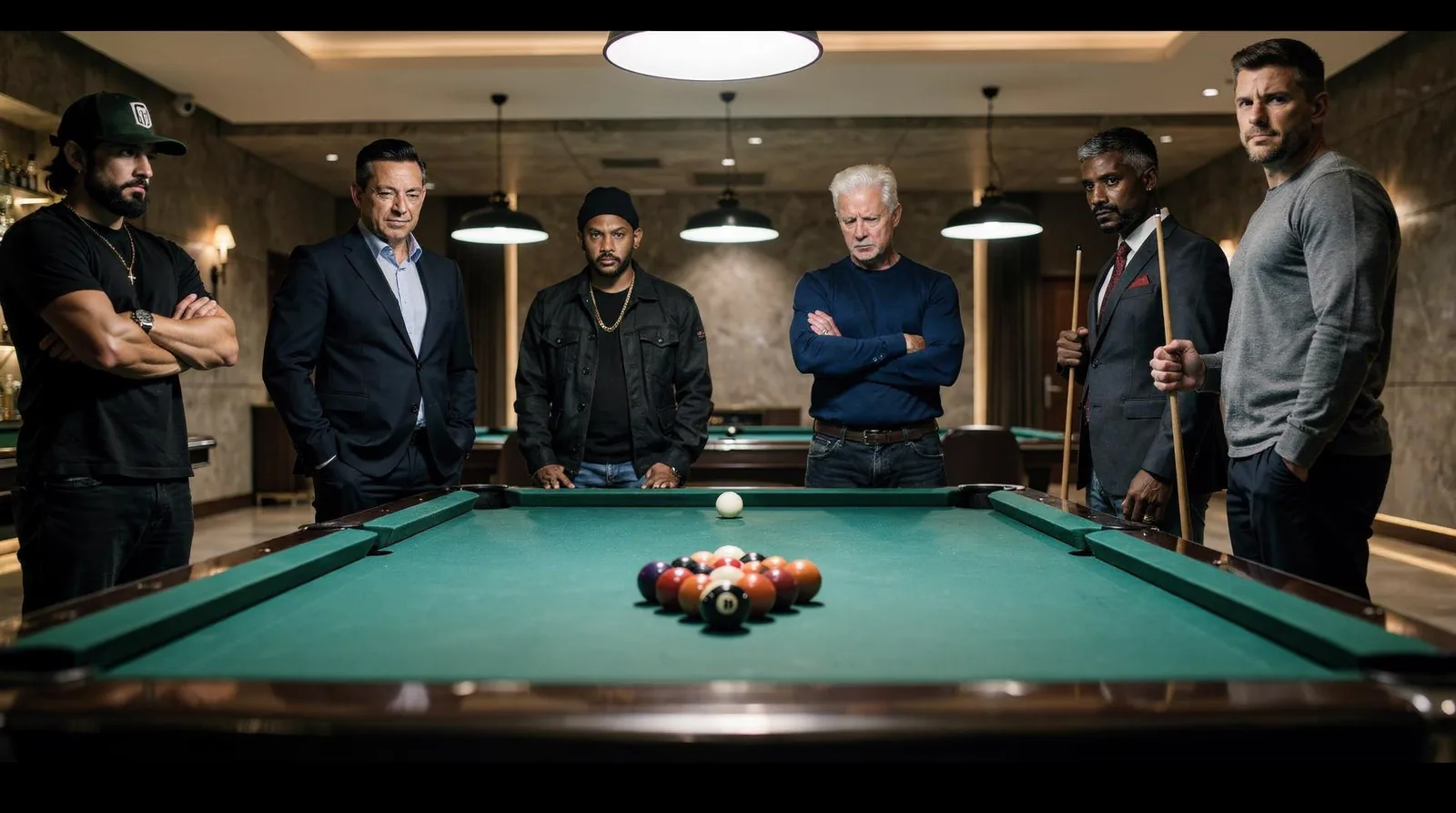
Gustave LaBlanc owns the Hotel-Casino Versailles and stages a high-stakes nine-ball match broadcast globally from Monaco. The match becomes the ultimate test of Cav's skill, nerve, and identity, pulling the narrative out of street-level hustling and onto a world stage built for spectacle. LaBlanc's wealth and showmanship turn pool from a survival tactic into a televised blood sport.
LaBlanc's confidence isn't empty bravado. He backs JunJun, a nine-ball prodigy many consider the best player alive, handing Cav a rival built to match his intelligence and instinct shot for shot. That pairing — outcast versus prodigy, underdog versus institution — is what makes morally complex characters in fiction central to the book rather than decorative.
- Marco: early-stage danger and moral testing within The Hustled's opening arc
- LaBlanc: late-stage spectacle and existential risk in Monaco
- JunJun: the rival whose skill forces Cav's evolution
**David Sutter author** of the novel adapted his 2017 screenplay into this literary crime thriller, weaving pool, gambling, and artistry into one character-driven crime fiction arc where every billionaire raises the cost of winning.
Why Does This Story Suit Screen and Rights Buyers?
Rights buyers find a ready-made three-act structure inside The Hustled book. Cav's arc from teen outcast to world-class pool strategist gives adaptation teams a clean spine: setup, escalation, reckoning. That transformation, paired with high-stakes games and a rebellious, ambitious tone, supplies the tension a trailer can be cut around without inventing a single beat.
**David Sutter author** wrote the property as a screenplay before turning it into a novel, and that origin shows on every page. Scenes carry blocking, stakes, and pacing baked in rather than layered on afterward. For acquisition executives scanning a crowded slate, a literary crime thriller built cinematically from page one cuts development risk down to size.
Does the source material fit episodic or feature formats?
The high-stakes games and hard-won transformations at the story's core scale either way. A feature can compress the arc into a single triumphant run. A series can stretch each hustle into its own escalating chapter, letting the tension build match by match.
What draws international rights buyers specifically?
Global pool-hustling settings and a redemption-driven throughline travel across markets and languages without heavy localization — a strong pitch for buyers assessing character-driven crime fiction for cross-border release.
Conclusion
In the end, David Sutter refuses to hand his readers easy villains or flawless heroes. Cav's brilliance is inseparable from his wounds, Esmeralda's grace shadowed by the weight of her world, and even men like Marco and Gustave LaBlanc pulse with ambitions that feel unnervingly human. This is the raw power of The Hustled: it forces us to sit at the table with morally complicated people and recognize, uncomfortably, pieces of ourselves in every calculated shot they take.